Where the Money Goes in a Small Gift or Travel Set Order
A travel set quoted at a high unit price is usually not being overcharged. It is carrying fixed costs — tooling, artwork, testing, documentation — across a small number of units. Understanding which lines are fixed and which are variable is what turns a price into something a buyer can negotiate, because only one of those two categories really moves with volume.
Key takeaways
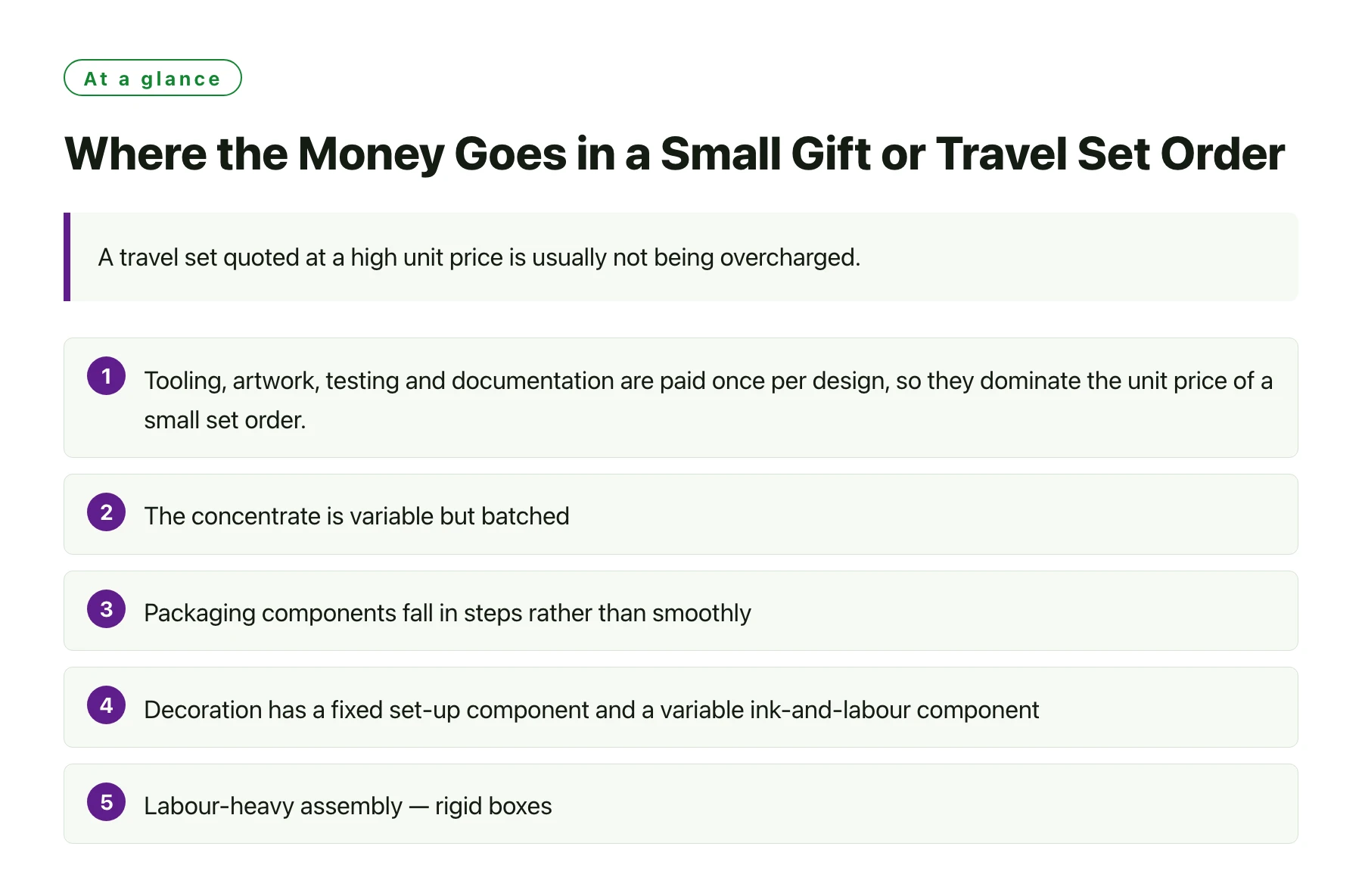
- Tooling, artwork, testing and documentation are paid once per design, so they dominate the unit price of a small set order.
- The concentrate is variable but batched, which means its cost per unit barely improves until the order crosses the perfumer's minimum batch.
- Packaging components fall in steps rather than smoothly, because container suppliers publish price breaks at fixed quantities.
- Decoration has a fixed set-up component and a variable ink-and-labour component, so its cost curve is steep at first and flat later.
- Labour-heavy assembly — rigid boxes, inserts, hand-wrapped sets — is the line that gets least benefit from volume and deserves the closest attention.
Buyers often compare quotations by looking at one number. That number is the sum of lines with completely different behaviours, and treating them as a single figure makes it impossible to see which supplier is genuinely cheaper or which design decision is driving the difference.
The list below separates a typical set order into its cost lines, marks each as fixed or variable, and describes how it behaves as volume rises. It is deliberately generic, because exact figures depend on the pack, the market and the moment.
One caveat before the detail: this is about cost structure, not about a specific price list. Any supplier who can walk you through these lines for your own pack is giving you something more useful than a discount.
Fixed costs are what make a small set look expensive
The lines that do not change with quantity are the reason a run of five hundred sets can cost three times per unit what a run of five thousand costs. They are not padding; they are work that has to happen once regardless of how many units come out of it.
A quotation that hides them in the unit price makes the product look uncompetitive at low volume and mysteriously cheap at high volume. A quotation that lists them separately lets the buyer decide whether each one is worth paying. The way a manufacturer describes its own scope before anyone asks, as on Xuelei's website, is a fair indication of how carefully it will itemise a quotation.
Tooling and artwork
Moulds, dies, screens, hot-stamping plates and assembly jigs are made once. Artwork separations, colour proofing and print-ready files belong in the same category. These items are typically paid before production starts, and their ownership should be stated in writing — a brand that has paid for a mould should hold it, or at least hold the right to move it.
Testing and documentation
Testing is quoted per test and per formula rather than per unit. Stability, compatibility with the pack, microbiological checks and any market-specific work are usually performed by third-party laboratories, whose published scope shows how many distinct tests a single cosmetic product can attract [2]. A set containing three formulas multiplies part of this cost by three.
Ingredient documentation sits alongside it. Labels and regulatory files reference standard ingredient names, and the EU's CosIng database is the reference list most export markets align with, which means the naming work has to be done before artwork is final rather than after [3].
Why compliance is a cost line, not an overhead
Rules on packaging and packaging waste in the EU set design and recyclability expectations for packaging placed on that market [1]. In practice that pushes designs toward fewer materials, less internal plastic and easier separation, which reduces both complexity and cost — a rare case where the compliant option is also the simpler one.
Formula restrictions work the same way. Where a material is limited by category or concentration, the perfumer has to reach for alternatives that may cost more or behave differently [4]. Knowing that at the brief stage lets you choose a direction that avoids the problem instead of paying to solve it later.
The cost lines in a set order and how each one behaves
| Cost line | Fixed or variable | What happens as volume rises |
|---|---|---|
| Tooling, moulds and dies | Fixed, paid once | No change; the main reason small orders carry a high unit cost |
| Artwork and colour proofing | Fixed, paid once | No change unless the design is revised |
| Fragrance concentrate | Variable but batched | Improves slowly until the order crosses the perfumer's minimum batch |
| Bottle, cap and pump | Variable, with break points | Falls in steps as you pass each container supplier's price break |
| Decoration | Mixed: fixed set-up plus variable ink and labour | Falls sharply at first, then flattens |
| Gift box and insert | Mixed: fixed die plus assembly labour | Falls with volume but stays sensitive to hand assembly time |
| Filling, packing and QC | Mostly variable | Falls slowly; line time and labour dominate |
| Testing and documentation | Fixed per formula and per market | Unchanged, and paid again for each new formula or version |
| Freight, duty and insurance | Variable by weight and route | Scales with volume; mode of transport matters more than order size |
Read the fixed column first. If a quotation's shape is not explained by these lines, ask which line the supplier has assumed differently.
Reading the cost curve properly
Ask for the same pack quoted at three quantities — the minimum, roughly double, and roughly four times. Plot the unit price. Most set projects produce a curve that drops steeply, then flattens, then drops again when a component break point is crossed. It is the same exercise as reading a perfume price breakdown, applied to your own numbers before you negotiate.
The flat section is the interesting one. It means you are paying for labour and set-up that do not scale, and adding volume buys you very little. If the flat section covers the range you actually plan to order, the honest conclusion is that the design is too custom for the volume, not that the supplier is expensive.
The second drop is also worth understanding. It is usually a container or box break point, where the supplier's own price changes because they are buying at a better rate. A buyer who knows where the next break sits can decide whether to move the order quantity slightly upward to capture it.
What actually moves the price
In rough order of impact on a first run: whether the bottle mould is new, whether the box is bespoke, how much of the decoration is set-up heavy, and how many formulas are involved. Everything else is comparatively minor.
That ordering is useful because it tells you where to spend your negotiation time. Arguing over the filling rate on a five-hundred-unit order is not worth the conversation. Removing one tooling item is.
Where the comparison between suppliers breaks down
Two suppliers can quote the same unit price and mean different things. One may have included testing and documentation; the other may have excluded them and left them to appear later as a separate invoice. Before comparing totals, confirm that both quotations cover the same scope and the same market requirements.
It also helps to ask how each supplier handles a formula change after approval. A change that requires new artwork, a new label version and a repeat of part of the testing has a real cost, and knowing who pays for it in advance prevents an awkward conversation at the worst moment.
The single most useful question about a set quotation is not why it costs that much. It is which line would disappear if the design were simplified. A supplier who answers that precisely is telling you where the money is, and that is the information a negotiation actually needs.
Legitimate ways to reduce cost without reducing quality
Use stock glass and standard closures, and put the differentiation into printing, the label and the box wrap. Share one concentrate across variants by building them from a common accord. Keep the number of formulas in the set as low as the concept allows. Schedule testing once for the whole range rather than per SKU where the pack is identical.
Where a manufacturer runs fragrance development and filling in the same building, as is the case for one-stop fragrance manufacturing, a change of concentrate does not have to wait for a third party, which shortens the sampling loop and reduces the cost of getting the scent right.
The line worth examining first is usually the one nobody questions: the box. A rigid box with a magnetic closure and a custom insert can cost more than the bottle and the juice combined. A well-printed folding carton with a shaped insert often presents just as well in a gift context.
Finally, check the cost against the supplier's own account of its scope. A manufacturer that publishes what it does in house and what it buys in — Xuelei's manufacturing background is a reasonable example of that kind of page — gives a buyer a way to tell which cost lines are being marked up by a middleman.
Sources
- European Commission: Packaging Waste and the PPWR —— EU rules on packaging and packaging waste, including the Packaging and Packaging Waste Regulation requirements on recyclability and design.
- SGS: Cosmetics, Personal Care & Household Testing —— Testing, inspection and certification services for cosmetics and personal care, including microbiological, stability and safety testing aligned with cosmetics GMP.
- EU CosIng — Cosmetic Ingredient Database (European Commission) —— The European Commission's CosIng database of cosmetic ingredients, listing ingredient functions, restrictions and labelling requirements under EU cosmetics law.
- IFRA Standards Library (International Fragrance Association) —— The IFRA Standards Library lists the restrictions the fragrance industry applies to individual fragrance ingredients, based on safety assessments; it is the reference point for compliant fragrance formulation.
Frequently asked questions
Why does a travel set cost more per millilitre than a full-size bottle?
Because the set carries the same fixed costs — tooling, artwork, testing, documentation — across less liquid and usually across more components. The glass, cap and decoration of a 10 ml bottle are not proportionally cheaper than those of a 50 ml bottle.
Should tooling be amortised into the unit price?
It is clearer to keep it separate. Amortising hides a real cost inside the unit price and makes the price look better than it is at low volumes. A separate line also records who owns the tooling, which matters if the relationship changes.
How much does decoration add?
It depends almost entirely on the method. A printed label or a single-colour screen print adds little at any volume. Spray coating, metallising and multi-colour hot stamping add a set-up charge that only makes sense on larger runs.
Do more variants always cost more?
More formulas do, because concentrate and testing are repeated. More variants that share the same bottle, cap, carton and box cost comparatively little extra, since the component tooling is already paid for.
When should freight enter the cost calculation?
At the brief stage, not at the end. Sets are bulky relative to their value, so volumetric weight and the choice between air and sea can change the landed cost by more than a design decision does. Ask for freight to be quoted as its own line.